"Limiting overshoot" is a wonderful phrase for describing failure. It is the title UNEP gave its latest report, which concedes in effect that the world will exceed the 1.5°C limit set at the Paris COP.
5 min read time
"Limiting overshoot" is awonderful phrase for describing failure. It is the title UNEP gave its latestreport, which concedes in effect that the world will exceed the 1.5°C limit setat the Paris COP.
The headline finding is that the world isnow set to cross the 1.5°C threshold, relative to pre-industrial levels, withinthe next few years, earlier than previously expected. That is an admission ofdefeat, even as the report tries to put it in context. The question has shiftedfrom "can we avoid it?" to "how do we limit how far above it wego, and for how long?"
The report is disappointing but probablyinevitable. The global unity of purpose that produced the Paris targets beganto fade once the scale of the task became hard numbers at national level. TheTrump administration's attitude weakened the resolve further, and for somecountries the consequences are already large and growing.
The numbers and the risks
Three figures from the report will probablyanchor the revised targets, and together they form one spectrum:
• If national pledges are fully met: peakwarming of around 1.8°C.
• If current policies continue unchanged:roughly 2.6°C of warming by 2100.
• Without stronger action: many scenariospeak well above 2°C.
Even the best case overshoots 1.5°C byabout 0.3°C.
The report also sets out the larger risks.We already see extreme weather around the world but what this assessmentenvisages goes well beyond anything we have observed. The longer and highertemperatures overshoot 1.5°C, the more likely the world is to triggerirreversible tipping points, including destabilisation of major ice sheets,degradation of the Amazon rainforest and disruption of Atlantic Oceancirculation. Each additional fraction of a degree intensifies the impacts.
From optimism to realism
My default position is optimistic as I havealways looked for the upside. But the pace of progress, the lack of urgency andthe competence of the leadership tasked with addressing climate change arepushing me towards realism.
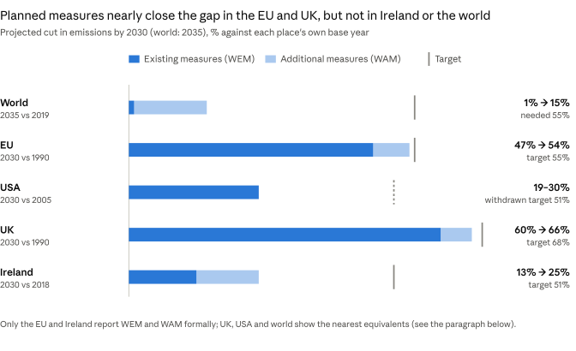
Two terms in national climate reportingexplain why. "With existing measures" (WEM) projects emissions on thepolicies already in force. "With additional measures" (WAM) adds themeasures governments have planned but not yet adopted. In business terms, WEMis the probable outcome and WAM is the possible one.
It is tempting to read the report's"pledges fully met" case as leaving room for upside. As Ireland'sfigures below show, even the WAM ceiling falls short of the legal target. Thegap has to be closed with policies that do not yet exist.
Where the promises stand
Only the EU and Ireland report WEM and WAMformally. For the UK the bars show the Climate Change Committee's credibleplans and the government's full plan. For the USA, current policies and for theworld, current policies against fully implemented NDCs. The US has noadditional-measures case because it has withdrawn its pledge.
In their words
UN Secretary-General António Guterres saysthe world must make the overshoot above 1.5°C "as small and short aspossible". The report puts the cost of delay plainly: "Every yearof delay and every fraction of a degree above 1.5°C increases risks and makesrecovery harder."